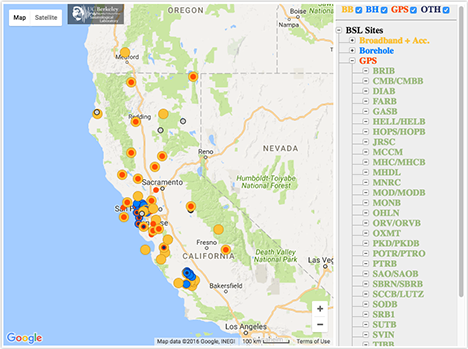
BRK - Haviland Hall, Berkeley, CA, USA
We operate broadband and borehole stations under the network code BK. The Berkeley Digital Seismic Network (BDSN) is a regional network of very broadband and strong motion seismic stations designed to monitor regional seismic activity as well as provide high quality data. The Berkeley borehole stations have borehole geophones or other seismic sensors and may have other geophysical instrumentation.
| Station Name | BRK |
| In Operation | 1996/08/16 00:00:00 - Present |
| Latitude | |
| Longitude: | |
| Elevation: | 49.4 meters |
| Instrumentation | Broadband |
Location
BRK is located on the campus of UC Berkeley in Haviland Hall. Over the years, recording at 4 separate sites on campus have used the station name BRK - the Student Observatory (beginning in 1887), Bacon Hall, Doe Library, Haviland Hall, and McCone Hall.BRK was one of the original sites for the Wood-Anderson seismographs deployed in 1930. The Wood-Andersons were operated at this site until they were relocated to BKS in 1962.
Network
Berkeley Digital Seismic Network (BK)Geology
Jurassic/Cretaceous Franciscan sandstone
Borehole Conditions
The instruments are sited in the sub-basement of Haviland Hall (a 2-story building) on the UC Berkeley campus. The piers were constructed when the building was built and were used over a number of years for various seismic instruments. In 1962, the Byerly vault was constructed and most of the critical instrumentation was relocated to BKS. The Seismological Laboratory decided to re-occupy the BRK site in 1994, in order to record data for comparison with historical paper records.This site is in an occupied building and is frequently noisy (particularly at high frequencies) during working hours. Although data acquisition began in 1994, only selected events were saved. Archiving of the data as a BDSN site began on 8/16/1996.
Station Pictures

Haviland Hall, UC Berkeley |
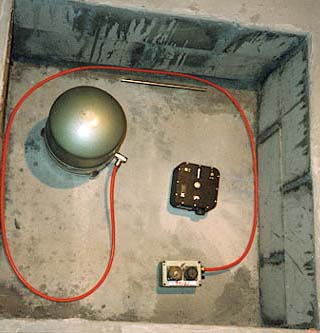
Typical STS-2 installation |
Table of Seismic Instrumentation
| Sensor | Datalogger | SEED Channels | Location | |
| Broadband | STS-2 | Q330HR | BH?,HH?,LH?,VH? | 00 |
| Accelerometer | EPISENSOR ES-T | Q330HR | HN? | 00 |
| Auxiliary | ANTENNACURRENT | Q330HR | VE? | 00 |
| CLOCKPHASE | Q330HR | LC?,VC? | 00 | |
| CLOCKQUALITY | Q330HR | LC?,VC? | 00 | |
| INPUTVOLTAGE | Q330HR | VE? | 00 | |
| SYSTEMCURRENT | Q330HR | VE? | 00 | |
| SYSTEMTEMPERATURE | Q330HR | VK? | 00 | |
| VCOVALUE | Q330HR | VC? | 00 |
Waveforms and associated metadata are available at the Northern California Earthquake Data Center (NCEDC).
Waveform Data
- BK Information Directory, including
- List of station locations
- List of available channels
- Instrument Response
- Querying the archives
- Download waveform data