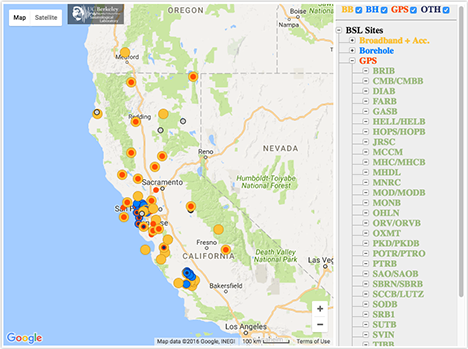
ORV - Oroville Dam
We operate broadband and borehole stations under the network code BK. The Berkeley Digital Seismic Network (BDSN) is a regional network of very broadband and strong motion seismic stations designed to monitor regional seismic activity as well as provide high quality data. The Berkeley borehole stations have borehole geophones or other seismic sensors and may have other geophysical instrumentation.
BARD is our GPS network for monitoring crustal deformation across the Pacific-North America plate boundary and in the San Francisco Bay Area for earthquake hazard reduction studies and rapid earthquake emergency response assessment
| Station Name | ORV (ORVB) |
| In Operation | 1992/07/31 18:50:00 - Present |
| Latitude | 39.55 |
| Longitude: | -121.5 |
| Elevation: | 340.0146 meters |
| Instrumentation | Broadband GPS |
Location
Site is located near the Oroville Dam, and is under the auspices of the CA Department of Water Resources.Network
Berkeley Digital Seismic Network (BK)Bay Area Regional Deformation Network (BARD)
Geology
Eocene basalt
Borehole Conditions
The vault is made of concrete, orientated north/south, and excavated into a hilltop. Approximately 1 meter of backfilled soil covers the top of the vault. The datalogger is located in an adjacent building (90' away) connected by conduits. The seismometers are thermally insulated with 4" of polyurethane foam. The accelerometer is co-located with the datalogger.GPS Monument Description
Reinforced concrete monument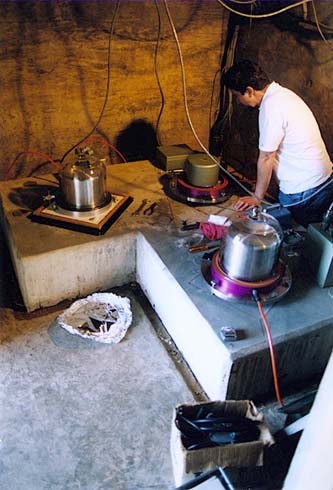
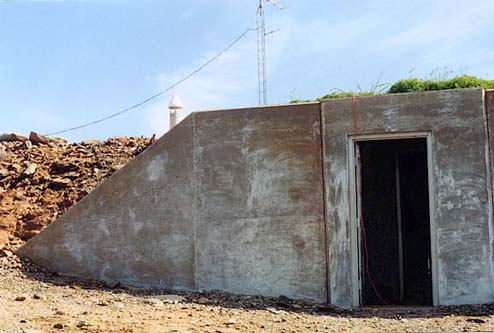
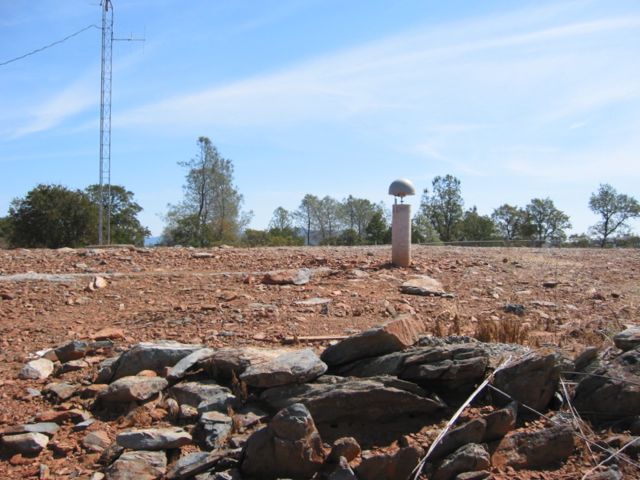
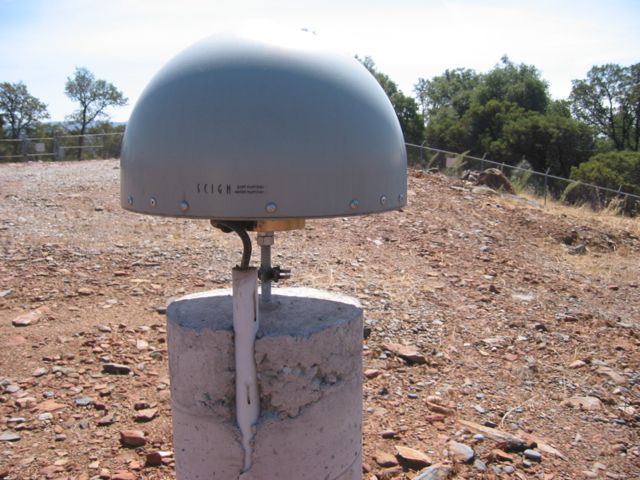
Table of Seismic Instrumentation
| Sensor | Datalogger | SEED Channels | Location | |
| Broadband | Streckeisen STS-1 VBB Feedback Horizontal Seismometer | Q330HR-GFE | BH?,HH?,LH?,VH? | 00 |
| Streckeisen STS-1 VBB Feedback Vertical Seismometer | Q330HR-GFE | BH?,HH?,LH?,VH? | 00 | |
| Accelerometer | Kinemetrics FBA ES-T Accel. GFE (4 g max 5v/g) | Q330HR-GFE | HN? | 00 |
| Auxiliary | AntennaCurrent | Q330HR-GFE | VE? | 00 |
| ClockPhase | Q330HR-GFE | LC?,VC? | 00 | |
| ClockQuality | Q330HR-GFE | LC?,VC? | 00 | |
| InputVoltage | Q330HR-GFE | VE? | 00 | |
| SystemCurrent | Q330HR-GFE | VE? | 00 | |
| SystemTemperature | Q330HR-GFE | VK? | 00 | |
| VCOValue | Q330HR-GFE | VC? | 00 | |
| CalibrationInput | Q330HR-GFE | LC? | EP | |
| Humidity | Q330HR-GFE | LI? | EP | |
| Pressure | Q330HR-GFE | LD? | EP | |
| Setra Systems Model 270 Barometer | Q330HR-GFE | LD? | EP | |
| Temperature | Q330HR-GFE | LK? | EP |
GPS Instrumentation
| Receiver | Antenna | Radome | - | |
| GPS | SEPTENTRIO POLARX5 | ASHTECH ASH700936D_M | SCIS | - |
Waveforms and associated metadata, and GPS data, are available at the Northern California Earthquake Data Center (NCEDC).
Waveform Data
- BK Information Directory, including
- List of station locations
- List of available channels
- Instrument Response
- Querying the archives
- Download waveform data
GPS Data
- Site log: orvb.log
Data Type From To Low-rate raw 11/21/1996 3/12/2008 Low-rate rinex 11/21/1996 present High-rate raw 3/12/2008 present High-rate rinex 5/1/2010 present
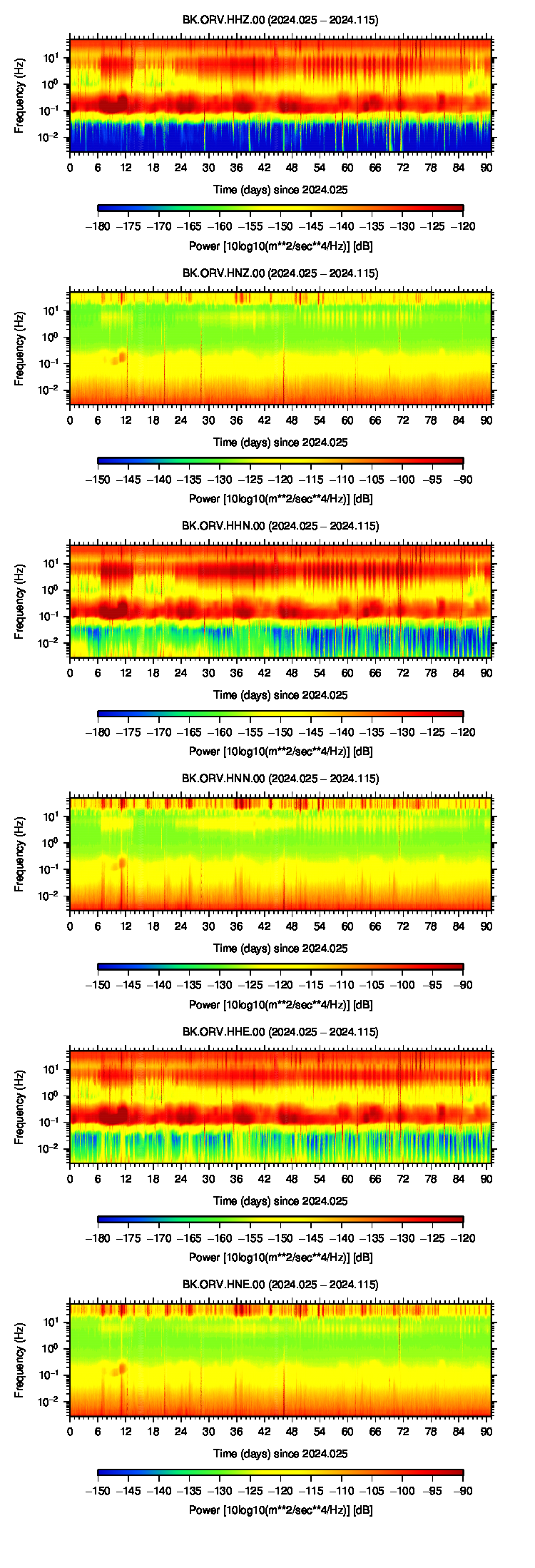
Noise Analysis
 |
GPS Data Quality
Completeness
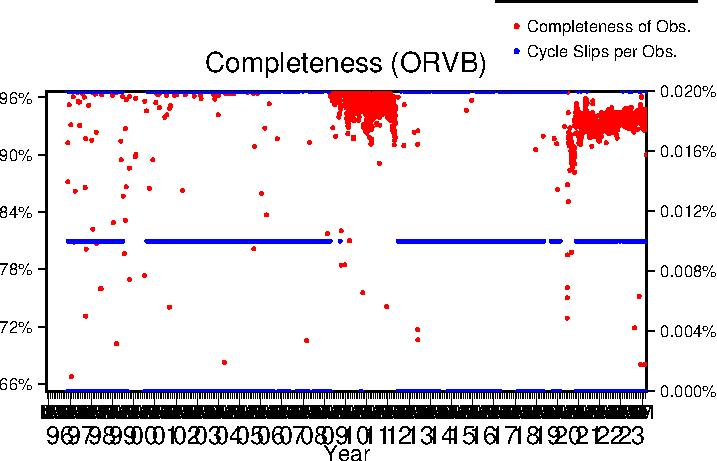
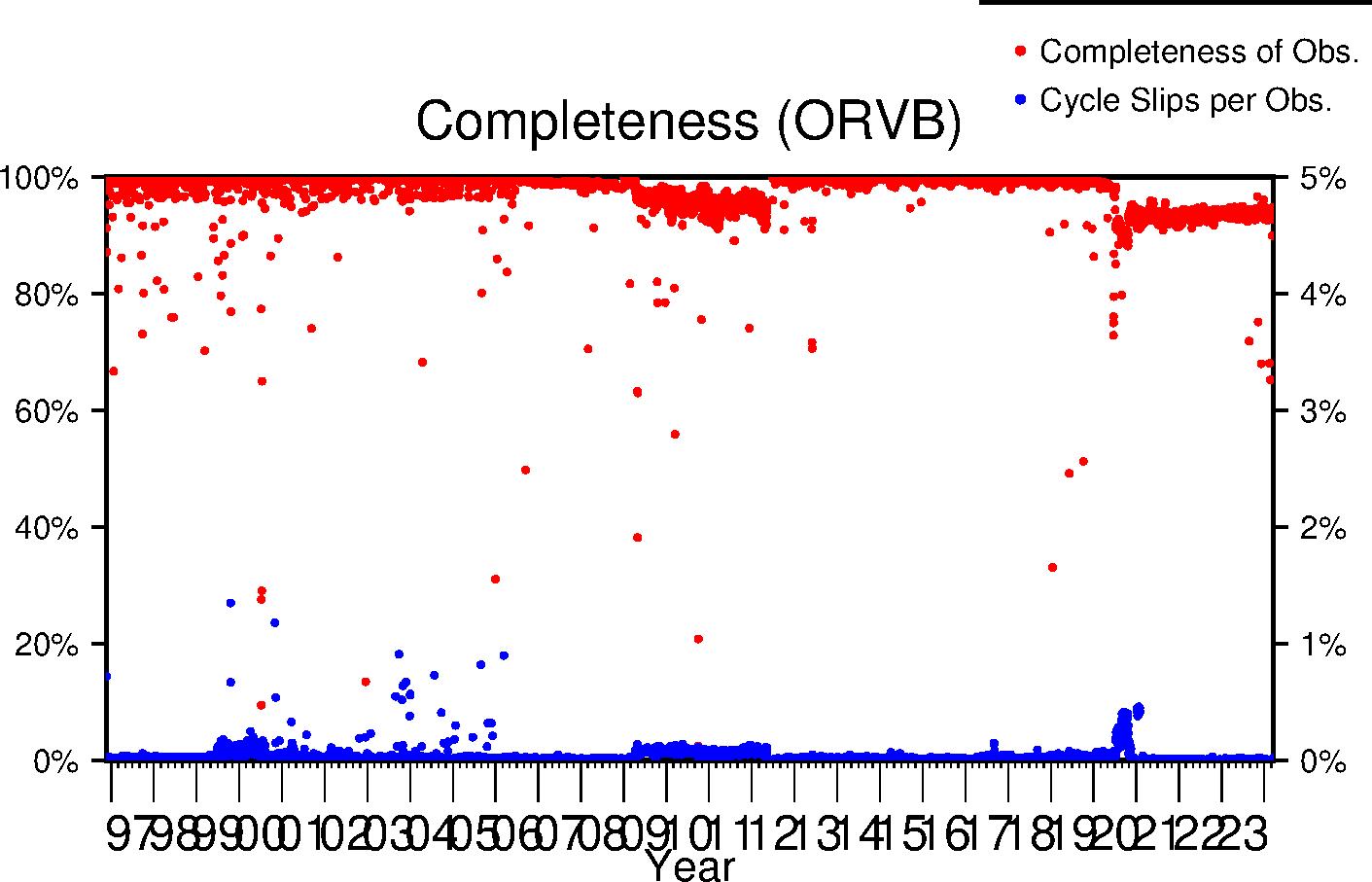
Data completeness is defined both as "Completeness of observations" and "Cycle slips per observation". "Completeness of Obs." is the number of epochs in the final RINEX file normalized to the expected number. This percentage will go down if time is missing from the RINEX file. "Cycle slips per Obs." is the total number of detected cycle slip normalized to the total number of observations in the RINEX file. This number will increase as the receiver loses lock on satellites more frequently.
| Previous Year |
 |
| Lifetime |
 |
Multipath
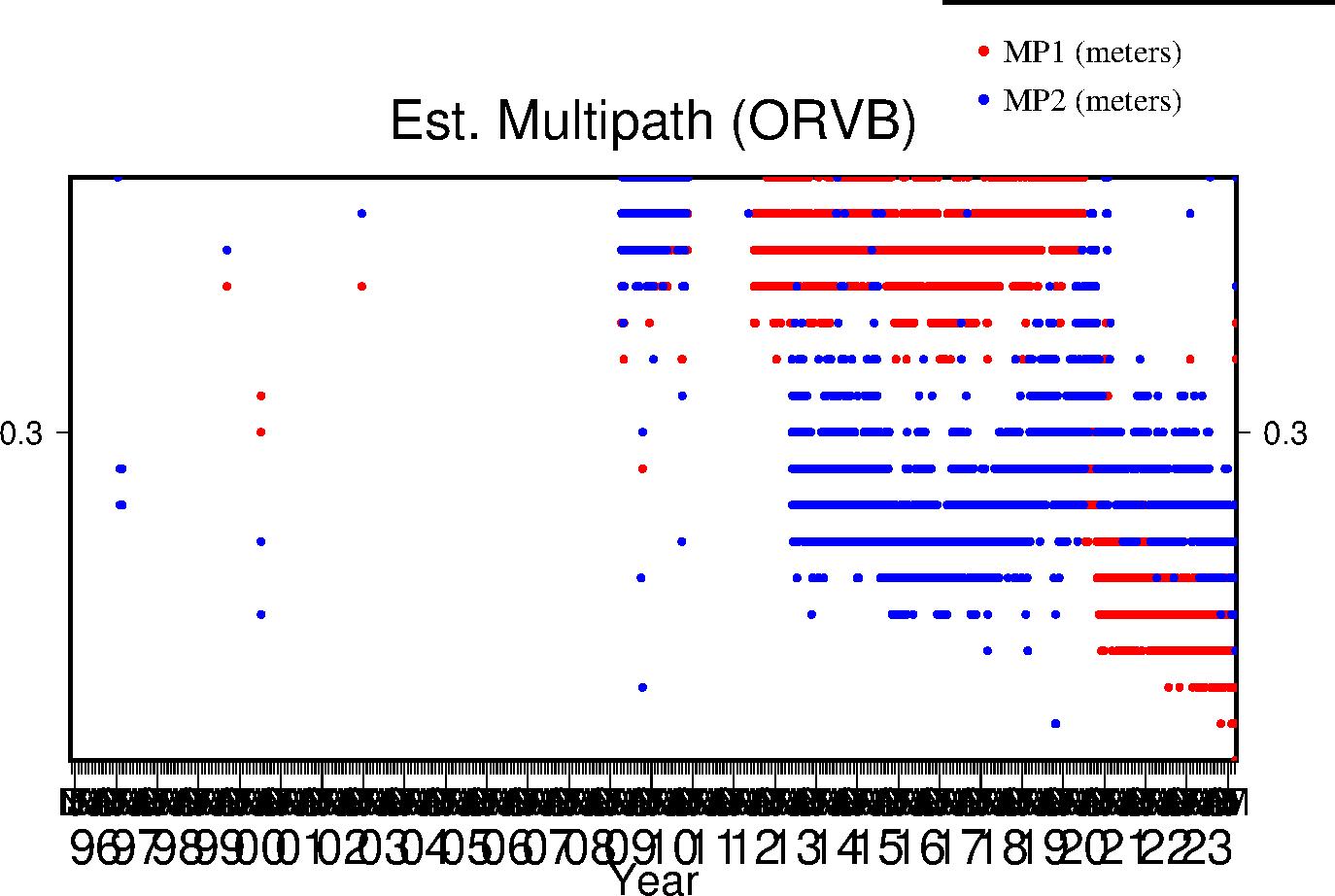
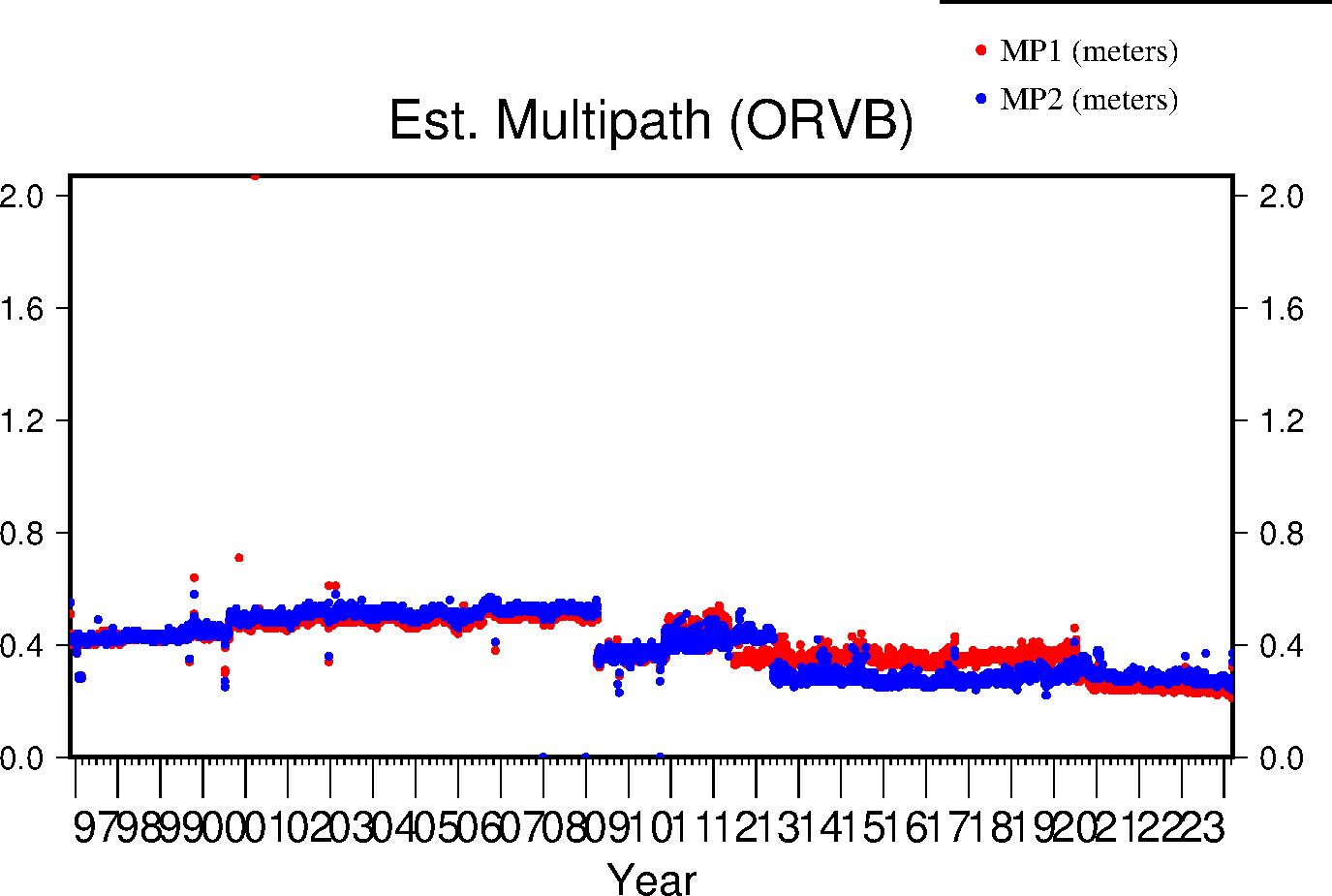
The effects of multipath on the data are estimated by parameters for L1 and L2 (MP1 and MP2 respectively); see Estey and Meertens (GPS Solutions, 1999) for derivation. The daily value is the RMS of MP1 and MP2 throughout the day and for all satellites. Higher values indicate a greater prevalence and/or strength of multipathing, i.e. objects on the ground are providing multiple reflection pathways from the satellite to antenna.
| Previous Year |
 |
| Lifetime |
 |
Signal-to-Noise Ratio
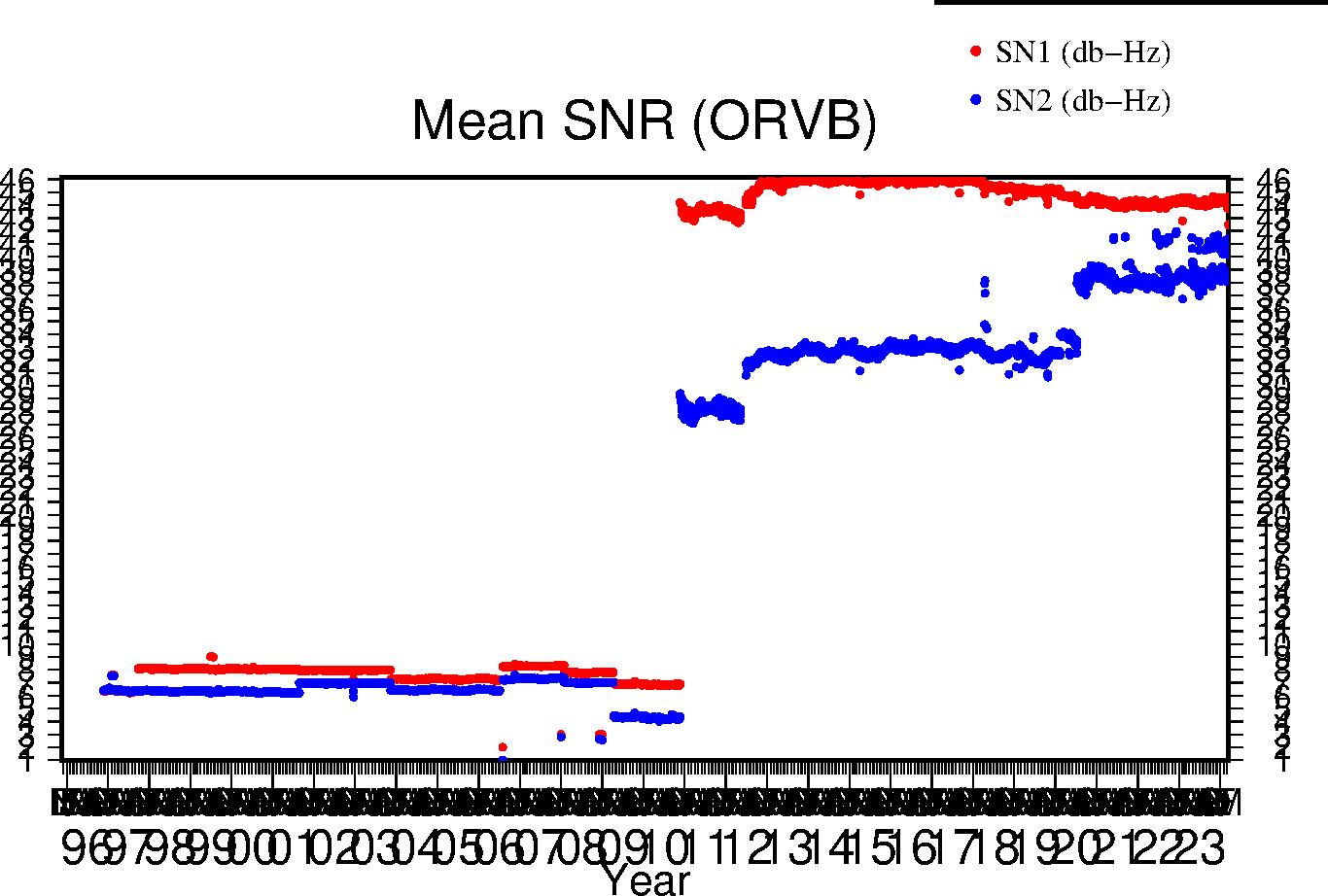
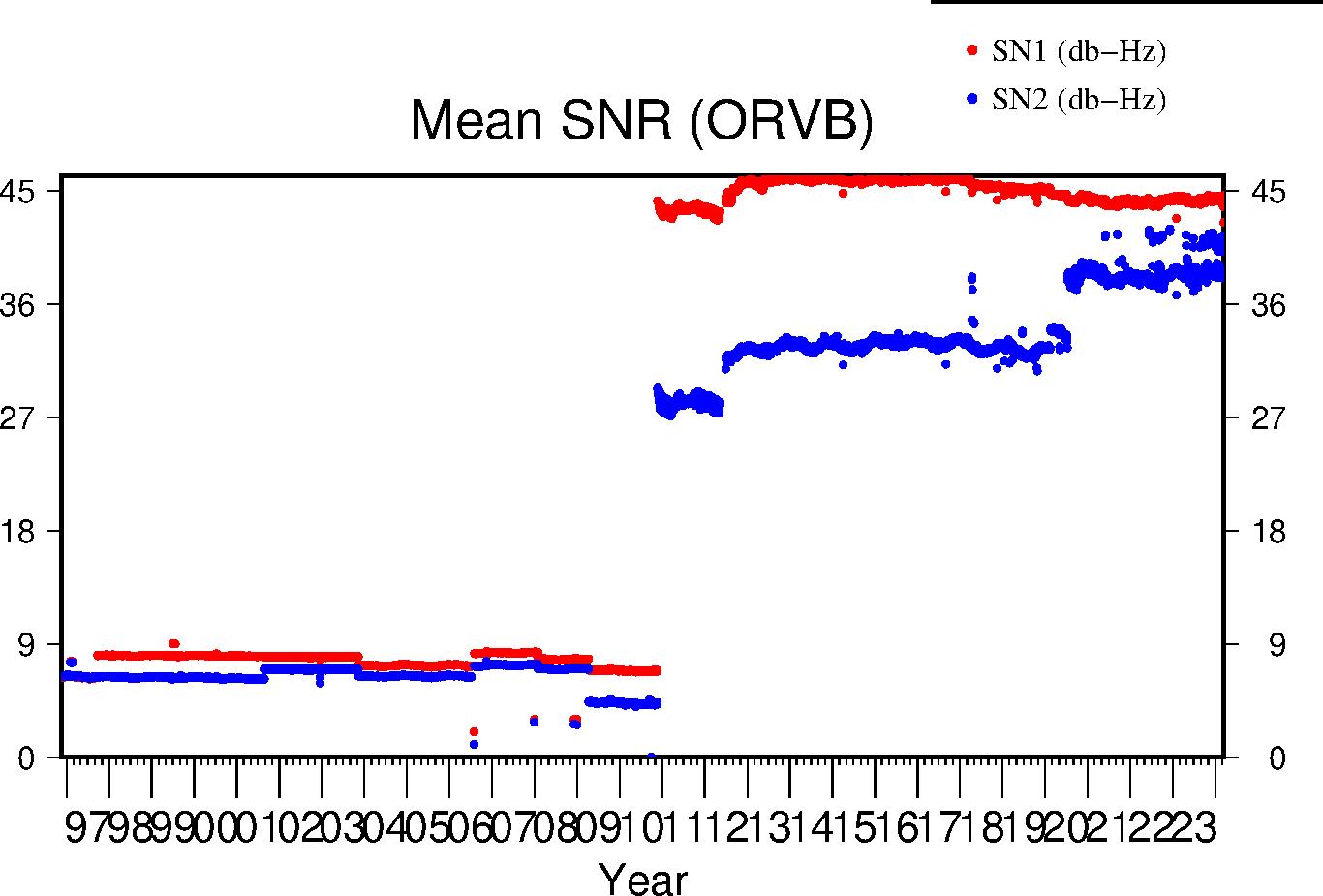
The Signal-to-Noise ratios are the mean values above the QC elevation mask for L1 and L2 respectively.
| Previous Year |
 |
| Lifetime |
 |