The primary goal of this exercise to motivate students to question why earthquakes occur where they do. In addition, the exercise will develop geography and mapping skills.
Through this exercise, students will acquire the basic skills of mapping, interpretation of latitude and longitude, and interpolation. This exercise can be used in conjunction with geography lessons. After plotting a number of events, students will begin to see that seismicity does not occur randomly on the surface of the earth.
The template maps come in two varieties: one with the continents and one without. Students will, in general, be familiar with the outline of the continents. Plotting the earthquakes on a map without those outlines may stimulate the students to ask questions about the relationship between earthquakes and continents, particularly as they begin to see how the earthquakes outline some of these boundaries.
Alternatively, any good basemap can be used for this exercise and you need not feel restricted to the set provided here. Once you have chosen your template map, make the appropriate number of copies for your students. This exercise may either be done in groups or by individual students, depending on their age and interests.
Now that you have selected your map, you need to have a list of earthquakes. We have put together several lists here, but these should not be viewed as limiting the exercise. For example, you or your students can generate earthquake lists by searching any of the many earthquake catalogs on the WWW. Most of these catalog programs employ forms which require you to specify a time period, a latitude-longitude box, and a magnitude cutoff. These catalogs are powerful tools for research projects in particular areas. Be judicious in your choice of parameters - or else you may end up with a long list! Bear in mind that approximately 100 earthquakes of magnitude 6.0-6.9 occur every year worldwide - but over 1000 earthquakes occur in the range from 5.0-5.9.
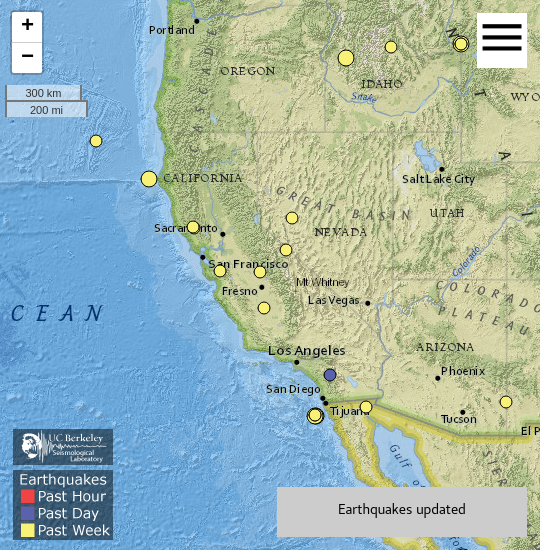
Another way to use this exercise is to take advantage of the fact that earthquakes occur all the time. You or your students could use the WWW to access current earthquake information. For example, a group of students could be responsible for making a list of earthquakes every week. A different group could be responsible each week. For any given week, only a handful of earthquakes would need to be plotted. Over the course of the year, however, the students would see the pattern of seismicity begin to emerge.
The final element for this exercise is "sticky" dots. Avery Corp, for example, makes dots in different colors and sizes. One approach is to use the same size dot for all earthquakes. However, you can convey information about the depth of an earthquake, as well as its magnitude, by using dots of different colors and sizes.
We suggest using different sizes of dots to indicate earthquake magnitude. For example, you could have 4 sets of dots: 5.0-5.9; 6.0-6.9; 7.0-7.9; and 8.0 and larger. Earthquakes are 3-dimensional phenomena, and one way to illustrate that on a 2-dimensional map is to use color to indicate the depth of an event. Seismologists generally classify earthquake depths in 3 catagories. Events are generally considered shallow if they occur as less than 70 kms (in California, for example, most seismicity occurs at depths of 15 km and less). An event is called intermediate if it occurs between 70 and 300 km. Finally, an event is considered deep if it occurs at depths greater than 300 km. In our maps, we have used yellow for shallow, orange for intermediate, and red for the deep events.
Armed with the maps, the earthquake lists, and the dots, have your students plot the location of each earthquake on the map. The templates are gridded coarsely in latitude and longitude and your students will need to interpolate in order to plot the earthquakes.
For each region, we selected several examples of earthquake lists and provided solution maps. The solution maps are drawn in either black and white (BW) or in color - and are available as either gif or postscript files.
For a description of the entries in the earthquake lists, see the following explanation.
Note: In these figures, the earthquakes are not plotted in time order. Because the number of shallow earthquakes exceeds the number of deep events, we have plotted the intermediate and deep focus events last.
| Template maps | Earthquake lists | # of Events | Solution Maps | |||
| with continents | w/o continents | Color | B&W | |||
| World | GifPS | GifPS | 1986-1996 M > 6.5 | 314 | GifPS | GifPS |
| 1995-1996 M > 5.8 | 520 | GifPS | GifPS | |||
| 1997 M > 5.0 | 535 | GifPS | GifPS | |||
| 1991-1996 M > 5.0 | 9073 | GifPS | GifPS | |||
| United States | GifPS | GifPS | 1996 M > 4.0 | 920 | GifPS | GifPS |
| California & Nevada | GifPS | GifPS | 1996 M > 3.5 | 127 | GifPS | GifPS |
| San Francisco Bay Area | GifPS | GifPS | 1996 M > 3.0 | 396 | GifPS | GifPS |
Other template maps and earthquake lists may be found in the earthquake plots created from the CNSS catalog.
Alternatively, this exercise can be done throughout the year, where students plot the current seismicity each week. As the year progresses, students will see the illumination of the plate boundaries. In this case, a good choice is to plot all events with magnitude 5.0 and larger. This will give you a few earthquakes each week. By proceeding in this manner, it is possible to build a component of the exercise where students forecast ares of future seismicity.
In a higher tech version of this exercise, the students can import the earthquake files in to plotting program on a computer and easily map seismicity in different regions or over different time periods. For example, students could look at foreshock/aftershock plots for large earthquakes. Or students could explore the question of whether the rate of seismicity is changing with time. Or examine the distribution of seismicity with depth. I hope to develop some of these questions into additional exercises, but there is an almost endless list of questions which may be explored with earthquake catalogs (which is why some of us become seismologists!).
12 November, 1997 - Lind S. Gee