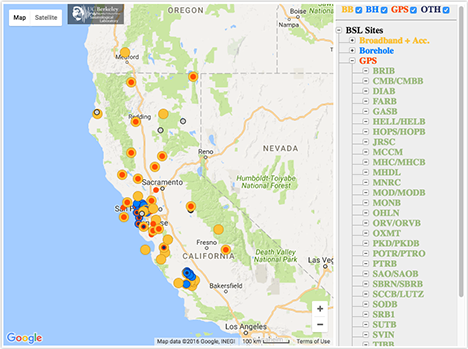
Parkfield High-Resolution Seismic Network Overview


|
The High-Resolution Seismic Network (HRSN) is one of several networks of seismic instrumentation in northern and central California operated by the Berkeley Seismological Laboratory. The HRSN is an array of borehole instrumentation deployed in the Parkfield area, with the goal of monitoring microseismicity on the San Andreas fault. The HRSN was initially deployed with 10 borehole stations in 1986 as part of a Vibroseis project during the Parkfield Prediction Experiment. It was quickly discovered that the earthquake data were well-recorded, so the system was upgraded in 1987 with accurate timing and triggering capabilities to capture the approximately daily local microearthquakes. The HRSN background describes the goals and design of the network and outlines the characteristics of the earthquake data set for the 1987-1998 time period. We strongly suggest that you read this document before using any of the HRSN earthquake data (particularly the older data). |
|
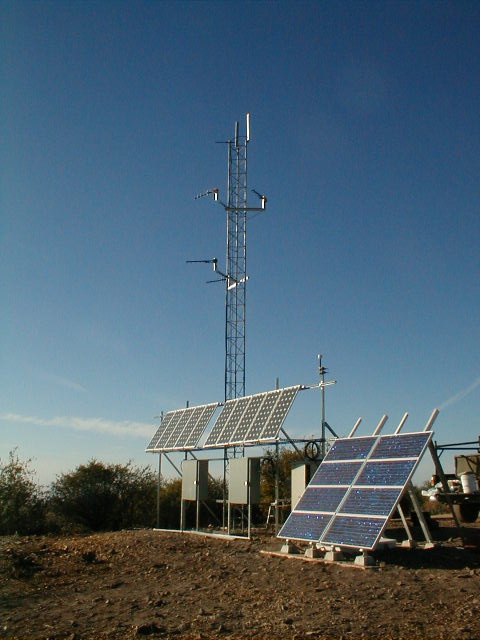
Gastro Peak Repeater Station
Over the years, the network has evolved and the operation of the HRSN can be divided into three stages:
- 1987-1998: Original HRSN data acquisition
- 1998-2000: PASSCAL RefTek recorders
- 2001-present: Q730 dataloggers and expansion to 13 stations
- Network Code
-
BP
- Current Station Equipment
-
3-component Mark Products L22 or Geospace HS1 or Litton 1023 sensor
Two Electrodes for EM studies on CCRB, LCCB, and SCYB
24-bit Quanterra digital data logger
80x preamplifier
GPS clock
Continuous telemetry to a central site; triggered events shipped to UC Berkeley
Backup power supply - Typical Recorded Channels
-
Sensor SEED Channels Rate (samples/sec) Sampling Mode FIR Filter Geophone DP1, DP2, DP3 250.0 Continuous (for centralized triggering) Casual Geophone BP1, BP2, BP3 20.0 Continuous (for centralized triggering) Acasual Vertical Electric array (CCRB,LCCB,SCYB) Data are not being recorded at this time - Network State of Health
-
Current projects include noise reduction at all sites.
- Station Information
-
- BP Information Directory, including
- List of station locations
- List of available channels
- Instrument Response
- History and Background of the HRSN
- Table of HRSN stations
- Reports on the HRSN from the Annual Report of the BSL:
- Karageorgi et al., BSSA, 82, 1388-1415, 1992.
- BP Information Directory, including
- Data access
-
The HRSN has evolved over time, with different recording systems and the
addition of new stations in 2000-2001. Data since March 2001 are available in
SEED format.
Several tools provide access to SEED format data at the
NCEDC, both in terms of querying the archives and
allowing data requests.
- Querying the archives
- Requesting data
Help on using these tools is available.
Please see the information on HRSN access for complete information on older HRSN data.
- Collaborations
-
The High-Resolution Seismic Network was deployed in collaboration with
LBNL. The recent network upgrade with the installation
of Quanterra dataloggers and the addition of 3 new borehole stations
is designed to provide coverage for the
San
Andreas Fault Observatory at Depth (SAFOD) drilling target with funding
provided by the USGS and NSF.
- Publications